Showing posts with label Labor and Wages. Show all posts
Showing posts with label Labor and Wages. Show all posts
Friday, December 16, 2011
"The hottest question in Europe" (amv)
is: "Did the ECB just pull off a Back-Door Bailout that will end the crisis?" by Simone Foxman. Reactions: Karl Smith, Modeled Behavior; Tyler Cowen, Marginal Revolution; Gareth Gore; Free Exchange (The Economist); Felix Salmon. I side with Smith and Salmon. Final update: Izabella Kaminska (FT Alphaville) resolves the issue (see also her previous post).

Wednesday, December 14, 2011
10 inconvenient Euro-truths by David Marsh (amv)
Excellent post by David Marsh (OMFIF):
Below are 10 key facts on the present position of the euro that many people overlook. Perhaps the most salient point concerns the direction of trade flows - the opposite of what you might expect. A classic case of ‘man bites dog’. The UK, a resolute non-member of the euro, has been busy over the past decade building trade ties with EMU. Yet Germany, in whose name and with whose currency monetary union was built, has been successfully integrating with the non-euro area – with fast-growing states in non-EMU Europe and Asia – and is doing progressively less trade with the euro bloc. Germany’s relative trade links with the peripheral countries have fallen particularly sharply. Considering these countries’ financing requires so much treasure from the taxpayers of Germany and other creditor countries, the imbalance between falling trade and rising demand for finance is at the bottom of the growing reluctance of the creditor countries to pledge more money to solve the conundrum. Confused about all this? Now read on.
Sunday, August 28, 2011
Jackson Hole Economic Symposium (fg)

Jackson Hole Economic Policy Symposium 2011.
Papers include topics on 'Assessing Current Trends in Global Growth', 'Balancing Growth with Equity', 'Managing Natural Resources in Developing Economies', 'Regulating Financial Markets and Institutions to Promote Growth, and 'Aligning International Capital Flows with Growth'.
A paper I find worth mentioning is from R. Levine on regulating financial markets and insitutions to promote growth:
A broader, long-run consideration of financial development suggests that financial innovation is essential for growth. [...] Without corresponding innovations in finance that match the increases in complexity associated with economic growth, the quality of the financial services diminishes, slowing future growth
Furthermore, both bank and stock market development are independently
associated with growth, suggesting that the policy debate about whether to promote a bank-based system or a market-based financial system misses the big point. Banks and markets matter for growth.
Wednesday, February 9, 2011
Inequality, leverage and crises (ls)
The IMF published a very interesting working paper. See also this article on voxeu for a short version.
Key thesis:
"Rising inequality in a climate of rising consumption can lead poorer households to increase their leverage, thereby making a crisis more likely."
The descriptive evidence seems to be striking:


The simulation results of their model look insightful as well:

Their reasoning is supported by several additional arguments:
Key thesis:
"Rising inequality in a climate of rising consumption can lead poorer households to increase their leverage, thereby making a crisis more likely."
The descriptive evidence seems to be striking:


The simulation results of their model look insightful as well:
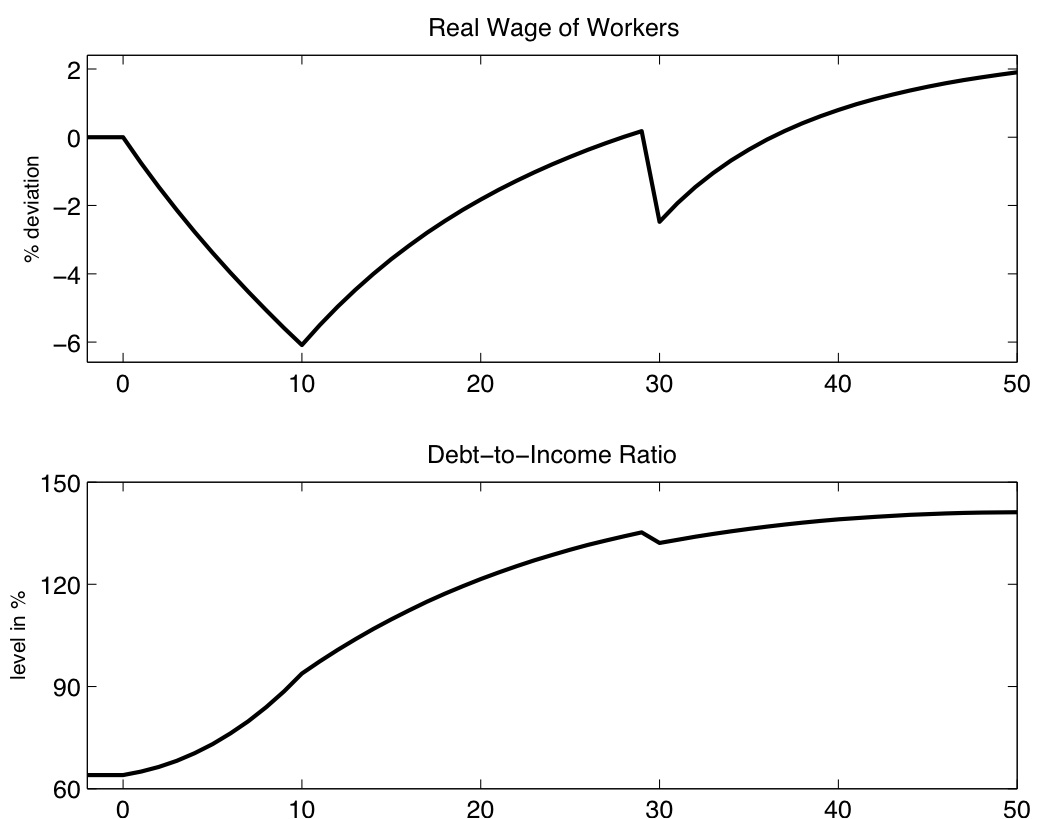
Their reasoning is supported by several additional arguments:
- Rajan (2010) argues that rising inequality creates a political incentive to facilitate the access of poorer people to mortgages and consumer loans.
- Fitoussi (2010) points out that rising inequality leads to an increase of the average propensity to save since rich agents tend to save a larger share of their income. This consequently brings down the average propensity of consumption and causes a persistent weakness in aggregate demand. Central banks respond to this developement by loosening their policy stance, thereby giving rise to the build-up of financial imbalances.
Friday, December 10, 2010
Follow up on Eichengreen (amv)
This post builds on the Eichengreen-paper introduced by ls (see below). I totally agree with Eichengreen as quoted by my fellow colleague. Eichengreen points to a major inconsistency in contemporary policy. Given the Eurosystem as it exists today, and thus the necessity to substitute internal for external devaluation, it is impossible to equilibrate imbalances and to protect claim holders at the same time. Internal devaluation necessitates haircuts!
Imbalances are unstable and some mechanism will inevitably correct them. We have no choice and must cope with this fact. Throwing good money after bad only sustains ill structures and accelerate adjustment costs. Usually, external devaluation is the mechanism that minimizes the costs of adjustment, which sustains the structure of production somewhat, but which of course doesn't eliminate the need for haircuts (since old claims have to be denoted in the new, weaker currency). Within the Eurozone we have to rely on changing relative prices and the associated reallocations of resources. To the extent weak members cannot produce more preferred commodities, or cannot produce the same commodities in a more efficient way, they must forego nominal and real income on their factors invested such that the tax base erodes (this is the case, since capital imports weren't used to import investment goods that enhance capacity, but wasted on foreign consumption goods or driving up domestic prices). Either way, prohibiting haircuts of €-denominated claims in face of adjustment processes must result in accelerating debt crises in fiscally weak Euromembers.
The point is that punishment of claim holders is a crucial aspect of this equilibrating process, as is the reward to those who hold claims to more useful economic activities. This relative asset-price adjustment on financial markets is an integral part of the general process of correction (often neglected in policy debates): control is taken from bad-decision makers and given to those, who invest in more preferred and thus more profitable processes - including government activities that rely on the capital market. In concrete, those who financed the activities of the Greek government should face a haircut, while those who have financed the activities of the German government can and should sell their bonds at profit.
Most importantly, this mechanism is automatic (the invisible hand at work, if you wish). There is no need for political decision-making to mimic the market process. Since policy discriminates against private institutional solutions to bankruptcy, the best it can do is to provide some feasible procedures itself. Yet, policy usually steps in to counteract the laws of markets. E.g., haircuts are countered to protect important hubs in the financial system, those institutions that are 'too big to fail'. For this reason Fama suggests heavy equity requirements for such big players (up to 40-50%!): because large institutions put the entire system at risk, investments in largeness should become increasingly risky as well, such that the design of incentives imposes sufficient constraints on dangerous activity (this, of course, comes at costs in terms of economies of scale which are presumably small).
There is, however, another reason why policy attempts to counter market forces, beyond the concern with financial fragility (BTW, you detect such attempts whenever you hear politicians lamenting over 'speculation' and undertaking measures to fight it.): governments are interested in protecting the owners of their debt. As vote-maximizing actors, politicians try to evade the uncompromising and incorruptible constraints imposed by financial markets on reckless spenders by shifting the burden of adjustment to succeeding generations. You remember, "in the long run we are all dead". Now this long run has become the present for some members of the Eurozone. Contemporary Greece, for instance, suffers from the fiscal sins of past administrations. The necessary adjustments have already grown to extremely high levels. Without allowing Greece to exist the Eurozone, such adjustments will continue for many years, if the population is willing to accept the burden.
Yet, European rescue packages continue the old habit of postponing (and thereby accelerating) adjustment costs. Transforming Europe into a gigantic transfer system is a most outraging attempt to neutralize market operations. The problem is that a complex adaptive systems like the economy cannot be managed other than by price signals which decentralize activity (and spreads on European bonds due to speculation are an integral part of the price system). Thus, we have to rely on the autopilot! Imposing a transfer union is like turning off the autopilot of a plane that you cannot fly. A bad idea for sure.
Imbalances are unstable and some mechanism will inevitably correct them. We have no choice and must cope with this fact. Throwing good money after bad only sustains ill structures and accelerate adjustment costs. Usually, external devaluation is the mechanism that minimizes the costs of adjustment, which sustains the structure of production somewhat, but which of course doesn't eliminate the need for haircuts (since old claims have to be denoted in the new, weaker currency). Within the Eurozone we have to rely on changing relative prices and the associated reallocations of resources. To the extent weak members cannot produce more preferred commodities, or cannot produce the same commodities in a more efficient way, they must forego nominal and real income on their factors invested such that the tax base erodes (this is the case, since capital imports weren't used to import investment goods that enhance capacity, but wasted on foreign consumption goods or driving up domestic prices). Either way, prohibiting haircuts of €-denominated claims in face of adjustment processes must result in accelerating debt crises in fiscally weak Euromembers.
The point is that punishment of claim holders is a crucial aspect of this equilibrating process, as is the reward to those who hold claims to more useful economic activities. This relative asset-price adjustment on financial markets is an integral part of the general process of correction (often neglected in policy debates): control is taken from bad-decision makers and given to those, who invest in more preferred and thus more profitable processes - including government activities that rely on the capital market. In concrete, those who financed the activities of the Greek government should face a haircut, while those who have financed the activities of the German government can and should sell their bonds at profit.
Most importantly, this mechanism is automatic (the invisible hand at work, if you wish). There is no need for political decision-making to mimic the market process. Since policy discriminates against private institutional solutions to bankruptcy, the best it can do is to provide some feasible procedures itself. Yet, policy usually steps in to counteract the laws of markets. E.g., haircuts are countered to protect important hubs in the financial system, those institutions that are 'too big to fail'. For this reason Fama suggests heavy equity requirements for such big players (up to 40-50%!): because large institutions put the entire system at risk, investments in largeness should become increasingly risky as well, such that the design of incentives imposes sufficient constraints on dangerous activity (this, of course, comes at costs in terms of economies of scale which are presumably small).
There is, however, another reason why policy attempts to counter market forces, beyond the concern with financial fragility (BTW, you detect such attempts whenever you hear politicians lamenting over 'speculation' and undertaking measures to fight it.): governments are interested in protecting the owners of their debt. As vote-maximizing actors, politicians try to evade the uncompromising and incorruptible constraints imposed by financial markets on reckless spenders by shifting the burden of adjustment to succeeding generations. You remember, "in the long run we are all dead". Now this long run has become the present for some members of the Eurozone. Contemporary Greece, for instance, suffers from the fiscal sins of past administrations. The necessary adjustments have already grown to extremely high levels. Without allowing Greece to exist the Eurozone, such adjustments will continue for many years, if the population is willing to accept the burden.
Yet, European rescue packages continue the old habit of postponing (and thereby accelerating) adjustment costs. Transforming Europe into a gigantic transfer system is a most outraging attempt to neutralize market operations. The problem is that a complex adaptive systems like the economy cannot be managed other than by price signals which decentralize activity (and spreads on European bonds due to speculation are an integral part of the price system). Thus, we have to rely on the autopilot! Imposing a transfer union is like turning off the autopilot of a plane that you cannot fly. A bad idea for sure.
Thursday, October 28, 2010
US Immigration Policy Deluxe (fg)
Poor conservative state representative candidate endorsed by Sarah Palin on US immigration policy - weird and crazy! What would the man who tore down the wall reply? Correct, "Don't mess with the Hoff!"...
haha!
You can find the audio tape here.
East Germany was very, very able to reduce the flow. Now, obviously, other things were involved. We have the capacity to, as a great nation, secure the border. If East Germany could, we could.
haha!
You can find the audio tape here.
Thursday, September 2, 2010

Friday, June 18, 2010
Highly Recommended (fg)
Please follow this link, an excellent review of latest developments in South Africa including a short presentation of its core industry.
Saturday, February 6, 2010
Trichet on Germany (fg)
From the latest press conference and Q&A:
Germany represents a very important part of the euro area, and so attention is of course paid to this particular economy. I think what we can say is that this country protected itself in the very difficult situation in which we were all put, particularly on the employment front, in a way which is quite impressive. We are all reflecting, not only in Europe but also at the global level, on the different behaviours that we have observed from the employment angle in various countries, to understand better what dynamics are at stake and what might explain those differences. Now, we will see what happens in this country, which is very highly internationalised, which has specialisations that are important, particularly as regards capital goods, machine tools, equipment and so forth. We will see exactly what happens when we have confirmation of the growing recovery in Asia, in particular in emerging Asian countries, and in the emerging world economies altogether. I expect that in this episode of the recovery, Germany will probably have more orders and more exports, which will contribute to its growth. I respond to the question because you asked a very specific question, but I cannot embark on responding to questions on particular countries
Monday, November 9, 2009
Kaltstart: The Economic Consequences of Mr. Kohl (amv)
Excellent interview by Hans-Werner Sinn.
UPDATE: What does not follow from Sinn's critical view is Fricke's narrow valuation. He really thinks that Hungary performs better in terms of economic performance and general welfare (East Germans would be better off without reunification, he says). The migration of East Germans (usually young women) to the West and their thereby increased marginal product is treated as a loss. In fact, however, these Germans are better of by making all of us richer. The much better institutional setting, the low degree of corruption, and the far better provision of public goods is also not taken into account. Further, an independent East Germany would be no member of the Eurozone (indeed, there would be no Euro but the insane Eurpean Monetary System which would be a catastrophe for West German exports right now). Just look at what has happened to Eastern European deficits!
UPDATE: What does not follow from Sinn's critical view is Fricke's narrow valuation. He really thinks that Hungary performs better in terms of economic performance and general welfare (East Germans would be better off without reunification, he says). The migration of East Germans (usually young women) to the West and their thereby increased marginal product is treated as a loss. In fact, however, these Germans are better of by making all of us richer. The much better institutional setting, the low degree of corruption, and the far better provision of public goods is also not taken into account. Further, an independent East Germany would be no member of the Eurozone (indeed, there would be no Euro but the insane Eurpean Monetary System which would be a catastrophe for West German exports right now). Just look at what has happened to Eastern European deficits!
Wednesday, June 10, 2009
Let them fail … God damn it! (amv)
This post is about some of the most elementary principles of economic theory, nothing really new and well known to economists since … mmmh …. say 1776, the year Adam Smith’s Wealth of Nations was published and the Declaration of Independence signed in the New World. You do not need to have a Ph.D. in economics or be a rocket scientist in any respect to understand the following outline. What motivates this post, however, is the lack of sound economic reasoning in most newspaper articles and in television news.
This morning (I am writing this around midnight, so it was rather yesterday morning), watching the Morgenmagazin, I was shocked by a lady (still) working for Karstadt and terribly afraid to lose her job. She even mentioned that her little daughter - who heard some rumors about mummy’s endangered job – confronted her with the situation … and mom openly concedes that this made her brake down in tears. She seemed absolutely devastated: ‘For such an such years I made a great job here and nevertheless my standard of living is threatened. How can this be? I did what I was supposed to do. Bla bla bla. I am not guilty - it’s someone elses fault, not mine. bla bla, thus: Mr./Mrs. Taxpayer, come and bail me out! Save my job!' Politics, especially the German social democrats under the lead of Mr. ‘I-have-no-clue-but-I-want-to-win–elections Steinmeier, attempts to ‘save every job, if possible’ and considers to help all those many poor fellows out there, who produce a marginal value product below their incomes (which is exactly the rule for outright populists and demagogues such as Steinmeier).
To a cold-hearted economist, however, the answer is straightforward: let all those companies go bankrupt that cannot generate revenues to balance their costs. Making losses is a clear signal: the resources employed in the provision of all the goods and services in question, from Opel cars to Karstadt stores, are more precious in other lines of production. Let the market take care of it: just imagine we would have frozen the structure of production 50 years ago, with the same line of reasoning put forward today: ‘but all those innocent people!’ The problem is: this is no question of guilt! And if someone is guilty than the consumers are, who arrogate themselves to buy something else. Honestly, do you have an Opel? Do you purchase your stuff at Karstadt? And why not! We work for our income, that is, also we have to supply our labor force and hope that someone can profit by maximizing someone else’s utility. Max U by making profit! It is the simultaneous occurrence of a variety of different people with different preference scales, a multitude of alternative productive opportunities and technological knowledge, and a complex system of highly differentiated resource endowments that generate profit and loss signals which guide resources to their most productive uses (thus defined).
Indeed, our mommy and the management of Karstadt are the true villains of this plot: they want the monopoly of power the give them our incomes which we obviously prefer to spend on someone else, on other mum’s and their kids! What rights do they have? What about all those mom’s and dad’s that would earn these incomes instead? Long, long time ago, Frederik Bastiat, a French journalist of the highest rank, distinguished between ‘what is seen and what is unseen’. What is seen are the jobs lost today. These jobs get public attention. What remains unseen are the jobs that could be created, if policy would not have intervened. These remain in the dark and nobody cares. The tyranny of the status quo!
The good news: a market economy is not a zero-sum game, so that every winner is evidence of someone losing. Just look at the long-run time series of per capita incomes … but compare those of market systems with those in which the tribe mentality of the masses is allowed to meddle with institutions and to destroy the market mechanism. So don’t get fooled by some pseudo-romantic ideas about social justice. In economic history many loosing industries claimed that they are too important and to profitable to leave the stage. If they were, why did they need the monopoly of power, coercing the general public to finance their employees way of life? In all these cases they sold their special interests as a matter of general welfare. This is no question of social justice – whatever this may be. So let them fail … God damn it!
This morning (I am writing this around midnight, so it was rather yesterday morning), watching the Morgenmagazin, I was shocked by a lady (still) working for Karstadt and terribly afraid to lose her job. She even mentioned that her little daughter - who heard some rumors about mummy’s endangered job – confronted her with the situation … and mom openly concedes that this made her brake down in tears. She seemed absolutely devastated: ‘For such an such years I made a great job here and nevertheless my standard of living is threatened. How can this be? I did what I was supposed to do. Bla bla bla. I am not guilty - it’s someone elses fault, not mine. bla bla, thus: Mr./Mrs. Taxpayer, come and bail me out! Save my job!' Politics, especially the German social democrats under the lead of Mr. ‘I-have-no-clue-but-I-want-to-win–elections Steinmeier, attempts to ‘save every job, if possible’ and considers to help all those many poor fellows out there, who produce a marginal value product below their incomes (which is exactly the rule for outright populists and demagogues such as Steinmeier).
To a cold-hearted economist, however, the answer is straightforward: let all those companies go bankrupt that cannot generate revenues to balance their costs. Making losses is a clear signal: the resources employed in the provision of all the goods and services in question, from Opel cars to Karstadt stores, are more precious in other lines of production. Let the market take care of it: just imagine we would have frozen the structure of production 50 years ago, with the same line of reasoning put forward today: ‘but all those innocent people!’ The problem is: this is no question of guilt! And if someone is guilty than the consumers are, who arrogate themselves to buy something else. Honestly, do you have an Opel? Do you purchase your stuff at Karstadt? And why not! We work for our income, that is, also we have to supply our labor force and hope that someone can profit by maximizing someone else’s utility. Max U by making profit! It is the simultaneous occurrence of a variety of different people with different preference scales, a multitude of alternative productive opportunities and technological knowledge, and a complex system of highly differentiated resource endowments that generate profit and loss signals which guide resources to their most productive uses (thus defined).
Indeed, our mommy and the management of Karstadt are the true villains of this plot: they want the monopoly of power the give them our incomes which we obviously prefer to spend on someone else, on other mum’s and their kids! What rights do they have? What about all those mom’s and dad’s that would earn these incomes instead? Long, long time ago, Frederik Bastiat, a French journalist of the highest rank, distinguished between ‘what is seen and what is unseen’. What is seen are the jobs lost today. These jobs get public attention. What remains unseen are the jobs that could be created, if policy would not have intervened. These remain in the dark and nobody cares. The tyranny of the status quo!
The good news: a market economy is not a zero-sum game, so that every winner is evidence of someone losing. Just look at the long-run time series of per capita incomes … but compare those of market systems with those in which the tribe mentality of the masses is allowed to meddle with institutions and to destroy the market mechanism. So don’t get fooled by some pseudo-romantic ideas about social justice. In economic history many loosing industries claimed that they are too important and to profitable to leave the stage. If they were, why did they need the monopoly of power, coercing the general public to finance their employees way of life? In all these cases they sold their special interests as a matter of general welfare. This is no question of social justice – whatever this may be. So let them fail … God damn it!
Monday, March 30, 2009
Einmal ein Keynesianer (amv)
Das Nominaleinkommen fällt. Nicht nur fällt die reale Ausbringung, bei dauerhaften Konsumgütern und Kapitalgüter fallen auch die Preise. Löhne passen sich äußerst träge an, sind in vielen Bereichen gar steigend, mit dem Ziel jene Erträge heute zu ernten, welche gestern enstanden und bereits verbraucht sind. Die ewige Debatte kommt in die nächste Runde: Was ist in der Krise zu tun? Setzen wir darauf, dass Preise von Einsatzfaktoren schneller fallen als Outputpreise? In diesem Fall enstehen Profite, zumindest für jene in der Konsumgüterindustrie. Dann bräuchten Ertragserwartungen der Industriegüterproduzenten ebenfalls nicht fallen, da Kapazitäten nicht abgebaut werden. Dann sollten wir soweit wie möglich Lohnrigiditäten aufbrechen und zulassen, dass temporär Einkommen fallen, so dass Arbeit während der Preisdeflation nicht freigesetzt werden muss. Um Ertragserwartungen zu stabilisieren, müssen die Löhne stärker fallen als die Preise, ganz analog zu den Kapitalkosten. Glauben wir aber nicht, dass wir Rigiditäten schnell genug beseitigen können, oder glauben wir nicht, dass das Glück uns gewogen ist und Kosten durch schieren Zufall schneller fallen als Erträge, so müssen den Abfall des Nominaleinkommens kompensieren, d.h. die effektive Nachfrage stützen. Wir müssen ausnahmsweise Keynesianer sein!
Eine Kontraktion des Nominaleinkommens hat keinerlei heilsame Wirkung, führt nur weg von einem Gleichgewicht und produziert keine Gegentendenz. Nominalwerte sind mit jedem Outputlevel vereinbar. Dies steht natürlich nicht im Gegensatz zu klassisch-neoklassischen Position, jedenfalls nicht wenn man sie wirklich kennt. Die Aussage, dass Arbeitslosigkeit allein ein Lohnproblem darstellt und durch fallende Reallöhne geheilt werden kann, gilt ceteris paribus, d.h. unter Annahme einer konstanten effektiven Nachfrage. Nur weil diese unverändert bleibt, und so auch die Relation zwischen aggregierter Nachfrage und gesamtwirtschaftlicher Ausbringung, bleiben bei fallenden Nominallöhnen die Güterpreise konstant und erlauben so, dass fallende Nominallöhne überhaupt den Reallohn und die Arbeitsnachfrage tangieren.
Bleibt bei allgemeinem Konsumverzicht die aggregierte Nachfrage konstant, müssen Nettoinvestitionen steigen, getrieben durch die aufgrund fallender Lohnsätze höheren Ertragsraten! Keynes bespricht denselben Zusammenhang unter der Annahme, dass Nominallöhne zusammen mit der effektiven Nachfrage einbrechen, dass Investitions- und Konsumausgaben zugleich fallen. Dies ist der relevante Fall für die Große Depression. Dies ist der relevante Fall, wenn wir die gleichen Fehler nicht zweimal machen möchten. Das Problem mit beiden Ansätzen ist, dass sie sich als Allgemeingültig erachten, den jeweils anderen Ansatz ausschließend. Funktionieren Banken als Intermediäre (also normalerweise), heilen fallende Löhne die Arbeitslosigkeit. Fallen sie als solche aus, dann fallen Preise und Kosten, der Reallohn bleibt mehr oder weniger unverändert; dann kontraktiert der Investitionsgütersektor zusammen mit der Konsumgüterproduktion. Die Arbeitslosigkeit steigt sukzessive, trotz oder gerade wegen fallender Löhne, mit einem Einkommensausfall nach dem anderen.
Es gibt aber nur eine Möglichkeit die effektive Nachfrage zu stützen. Es muss genügend Geldmenge bereitgestellt werden, um die erhöhte gesamtwirtschaftliche Liquiditätspräferenz zu bedienen und so zu verhindern, dass Banken Ersparnisse horten und ihre Kreditvergabe drosseln um Nettozuflüsse zu generieren. Nur soweit dies funktioniert, ist die steigende Ersparnisbildung - der Konsumverzicht - unproblematisch. Die aktuelle Deflation der Investitionsgüterpreise spricht aber ein deutliche Sprache: Die Banken fallen als Intermediäre aus. Die Geldpolitik ist demnach zurecht expansiv. Sie hat die Refinanzierung bereits erheblich verbilligt, die FED bietet den Banken Geldbasis frei Haus. Doch die Zentralbanken bestimmen nur über den Geldbasisbestand; es sind die Marktteilnehmer, die über dessen Effektivität als Nachfrage bestimmen; es sind die Banken, die über ihre Reservesätze bestimmen. "Quantitative Easing" bläht zudem die Zentralbankenbilanz mit giftigen Papieren auf, die bei Abschreibung das Eigenkapital auffressen und die Zentralbank von Zuschüssen aus den jeweiligen Finanzministerien abhängig machen. Viel schlimmer noch: Fallen die Papiere im Wert, kann man die durch ihren Kauf geschöpfte Geldbasis nicht zurückkaufen. Die Zinsen müssen dann radikal steigen, und dass schon bald nach dem Einsetzen der Konjunktur. Anderfalls wird die Geldbasis schnell nachfragewirksam. Banken verringern ihren Reservesatz, die allgemeine Umlaufsgeschwindigkeit des Geldes nimmt zu. Kapazitäten werden schnell gefüllt, umso schneller je mehr Kapital zuvor abgebaut wurde und insofern je länger die Krise dauert. Güterpreise steigen und es besteht kaum Hoffnung dass dieser Prozess bei Vollauslastung zu seinem Ende kommt.
In beiden Fällen, in und nach der Krise, muss die Fiskalpolitik der Geldpolitik unter die Arme greifen. Momentan muss sie als Brücke fungieren, d.h. die geschöpfte Geldmenge in Zirkulation bringen. Der Staat muss sich verschulden, Staatsanleihen produzieren. Er produziert bei niedrigen Zinsen nahezu perfekte Geldsubstitute, d.h. Reserven die bei Geschäftsbanken hinsichtlich ihrer Wertaufbewahrungsfunktion ähnlich geschätzt werden wie Zentralbankguthaben, während der extrem niedrige Refinanzierungssatz noch Raum für Profitmöglichkeiten lässt, und so Banken die von der Zentralbank geschöpften Mittel gegen Staatsanleihen tauschen und so für die Zirkulation freisetzen.
Die Politik sollte die so freigesetzte Liquidität jedoch nicht nach tagespolitischen Erwägungen verausgaben. Wir korrumpieren gerade unser marktwirtschaftliches System, händigen es Interessensgruppen und der allgemeinen Hysterie aus. Wir greifen in Marktprozesse ein, verpfälschen den Wettbewerb und verhindern Lerneffekte.
Um sich weitestgehend neutral zu verhalten, sollte die Ausgabenseite sowohl die Investitions- als auch die Konsumgüterindustrien stimulieren. Um Verzerrungen weitestgehen zu vermeiden, sollten Konsumausgaben durch Steuergutscheine zugänglich gemacht werden. Dann entscheidet der Konsument. Die Verringerung von Steuersätzen ist eine grundsätzlich richtige Entscheidung und sollte ganz grundsätzlich vorgenommen werden. Allerdings sollten wir uns überlegen, ob wir das Arbeitsangebot inmitten einer Nachfragekrise stimulieren möchten oder nicht doch eher dannach. J. Cochranes Vorschlag folgend, sollten Investitionsmittel auf Primärmärkten angeboten werden, dass heißt auf den Märkten für Neuemissionen. Sie treiben den Zins an der entscheidenden Stelle nach unten und forcieren Nettoinvestitionen. Dabei sollten die Mittel gleichsam auf ein Portfolio verteilt werden, so dass insolvente Unternehmen mit extrem hohen Finanzierungsbedarf nicht bedient werden. Deren Insolvenz erlaubt trotz Stabilisierung der Nachfrage eine gewisse Auslese. Dies gilt natürlich auch für einzelne Banken deren Ausfall auf dem Interbankenmarkt durch die Zentralbank kompensiert werden kann und deren Einlagenkontraktion durch die Fiskalpolitik neutralisiert wird. No one is too big to fail! Geld- und Fiskalpolitik können zusammen die Geldzirkulation aufrecht erhalten.
Ist die Krise vorbei so zahlt es sich aus, dass der Staat nun in Besitz von neu emittierten und im Durchschnitt gesunden Unternehmensanleihen und anderen privaten Finanztiteln ist. Diese erlauben es dem Staat seine Schuldpapiere schnell aus der Zirkulation abzuziehen. Die in der Krise geschaffene Staatsschuld wird nichtig. Im Gegenzug sind nun private Banken in Besitz privater Wertpapiere und die Marktwirtschaft bleibt erhalten. Alternativ kann sich der Staat bei der Zentralbank verschulden (allerdings müssten hier bestehende Gesetze verändert werden): die Staatsanleihen wandern in die ZB-Bilanz, deren Bilanzverlängerung wird aber vom Staat gespart (gehortet oder "verbrannt"). Die Zentalbank ist dann in der Lage trotz Abschreibungen die zuvor geschöpfte Geldbasismenge zurückzukaufen. Allerdings haben wir insoweit ein Entscheidungsproblem: Denn in diesem Fall wären die Staatsanleihen wieder in privater Zirkulation und das bei gesunkener Geldmenge. Nicht nur belastet die Staatsschuld zukunftige Steuerzahler (und reduziert gegebenenfalls das Ressourcenangebot), es steigen zudem Kreditzinsen und bremsen Nettoinvestitionen. Also gibt es Grenzen der expansiven Geld- und Fiskalpolitik, jedenfalls in Hinblick auf die mittlere Frist. Diese Grenze ist umso schneller erreicht, je eher die Bonität der Staatspapiere in Frage gestellt wird. Vielleicht tut Obama hier ein bißchen zu viel des Guten. Und viele europäische Staaten ebenso.
Eine Kontraktion des Nominaleinkommens hat keinerlei heilsame Wirkung, führt nur weg von einem Gleichgewicht und produziert keine Gegentendenz. Nominalwerte sind mit jedem Outputlevel vereinbar. Dies steht natürlich nicht im Gegensatz zu klassisch-neoklassischen Position, jedenfalls nicht wenn man sie wirklich kennt. Die Aussage, dass Arbeitslosigkeit allein ein Lohnproblem darstellt und durch fallende Reallöhne geheilt werden kann, gilt ceteris paribus, d.h. unter Annahme einer konstanten effektiven Nachfrage. Nur weil diese unverändert bleibt, und so auch die Relation zwischen aggregierter Nachfrage und gesamtwirtschaftlicher Ausbringung, bleiben bei fallenden Nominallöhnen die Güterpreise konstant und erlauben so, dass fallende Nominallöhne überhaupt den Reallohn und die Arbeitsnachfrage tangieren.
Bleibt bei allgemeinem Konsumverzicht die aggregierte Nachfrage konstant, müssen Nettoinvestitionen steigen, getrieben durch die aufgrund fallender Lohnsätze höheren Ertragsraten! Keynes bespricht denselben Zusammenhang unter der Annahme, dass Nominallöhne zusammen mit der effektiven Nachfrage einbrechen, dass Investitions- und Konsumausgaben zugleich fallen. Dies ist der relevante Fall für die Große Depression. Dies ist der relevante Fall, wenn wir die gleichen Fehler nicht zweimal machen möchten. Das Problem mit beiden Ansätzen ist, dass sie sich als Allgemeingültig erachten, den jeweils anderen Ansatz ausschließend. Funktionieren Banken als Intermediäre (also normalerweise), heilen fallende Löhne die Arbeitslosigkeit. Fallen sie als solche aus, dann fallen Preise und Kosten, der Reallohn bleibt mehr oder weniger unverändert; dann kontraktiert der Investitionsgütersektor zusammen mit der Konsumgüterproduktion. Die Arbeitslosigkeit steigt sukzessive, trotz oder gerade wegen fallender Löhne, mit einem Einkommensausfall nach dem anderen.
Es gibt aber nur eine Möglichkeit die effektive Nachfrage zu stützen. Es muss genügend Geldmenge bereitgestellt werden, um die erhöhte gesamtwirtschaftliche Liquiditätspräferenz zu bedienen und so zu verhindern, dass Banken Ersparnisse horten und ihre Kreditvergabe drosseln um Nettozuflüsse zu generieren. Nur soweit dies funktioniert, ist die steigende Ersparnisbildung - der Konsumverzicht - unproblematisch. Die aktuelle Deflation der Investitionsgüterpreise spricht aber ein deutliche Sprache: Die Banken fallen als Intermediäre aus. Die Geldpolitik ist demnach zurecht expansiv. Sie hat die Refinanzierung bereits erheblich verbilligt, die FED bietet den Banken Geldbasis frei Haus. Doch die Zentralbanken bestimmen nur über den Geldbasisbestand; es sind die Marktteilnehmer, die über dessen Effektivität als Nachfrage bestimmen; es sind die Banken, die über ihre Reservesätze bestimmen. "Quantitative Easing" bläht zudem die Zentralbankenbilanz mit giftigen Papieren auf, die bei Abschreibung das Eigenkapital auffressen und die Zentralbank von Zuschüssen aus den jeweiligen Finanzministerien abhängig machen. Viel schlimmer noch: Fallen die Papiere im Wert, kann man die durch ihren Kauf geschöpfte Geldbasis nicht zurückkaufen. Die Zinsen müssen dann radikal steigen, und dass schon bald nach dem Einsetzen der Konjunktur. Anderfalls wird die Geldbasis schnell nachfragewirksam. Banken verringern ihren Reservesatz, die allgemeine Umlaufsgeschwindigkeit des Geldes nimmt zu. Kapazitäten werden schnell gefüllt, umso schneller je mehr Kapital zuvor abgebaut wurde und insofern je länger die Krise dauert. Güterpreise steigen und es besteht kaum Hoffnung dass dieser Prozess bei Vollauslastung zu seinem Ende kommt.
In beiden Fällen, in und nach der Krise, muss die Fiskalpolitik der Geldpolitik unter die Arme greifen. Momentan muss sie als Brücke fungieren, d.h. die geschöpfte Geldmenge in Zirkulation bringen. Der Staat muss sich verschulden, Staatsanleihen produzieren. Er produziert bei niedrigen Zinsen nahezu perfekte Geldsubstitute, d.h. Reserven die bei Geschäftsbanken hinsichtlich ihrer Wertaufbewahrungsfunktion ähnlich geschätzt werden wie Zentralbankguthaben, während der extrem niedrige Refinanzierungssatz noch Raum für Profitmöglichkeiten lässt, und so Banken die von der Zentralbank geschöpften Mittel gegen Staatsanleihen tauschen und so für die Zirkulation freisetzen.
Die Politik sollte die so freigesetzte Liquidität jedoch nicht nach tagespolitischen Erwägungen verausgaben. Wir korrumpieren gerade unser marktwirtschaftliches System, händigen es Interessensgruppen und der allgemeinen Hysterie aus. Wir greifen in Marktprozesse ein, verpfälschen den Wettbewerb und verhindern Lerneffekte.
Um sich weitestgehend neutral zu verhalten, sollte die Ausgabenseite sowohl die Investitions- als auch die Konsumgüterindustrien stimulieren. Um Verzerrungen weitestgehen zu vermeiden, sollten Konsumausgaben durch Steuergutscheine zugänglich gemacht werden. Dann entscheidet der Konsument. Die Verringerung von Steuersätzen ist eine grundsätzlich richtige Entscheidung und sollte ganz grundsätzlich vorgenommen werden. Allerdings sollten wir uns überlegen, ob wir das Arbeitsangebot inmitten einer Nachfragekrise stimulieren möchten oder nicht doch eher dannach. J. Cochranes Vorschlag folgend, sollten Investitionsmittel auf Primärmärkten angeboten werden, dass heißt auf den Märkten für Neuemissionen. Sie treiben den Zins an der entscheidenden Stelle nach unten und forcieren Nettoinvestitionen. Dabei sollten die Mittel gleichsam auf ein Portfolio verteilt werden, so dass insolvente Unternehmen mit extrem hohen Finanzierungsbedarf nicht bedient werden. Deren Insolvenz erlaubt trotz Stabilisierung der Nachfrage eine gewisse Auslese. Dies gilt natürlich auch für einzelne Banken deren Ausfall auf dem Interbankenmarkt durch die Zentralbank kompensiert werden kann und deren Einlagenkontraktion durch die Fiskalpolitik neutralisiert wird. No one is too big to fail! Geld- und Fiskalpolitik können zusammen die Geldzirkulation aufrecht erhalten.
Ist die Krise vorbei so zahlt es sich aus, dass der Staat nun in Besitz von neu emittierten und im Durchschnitt gesunden Unternehmensanleihen und anderen privaten Finanztiteln ist. Diese erlauben es dem Staat seine Schuldpapiere schnell aus der Zirkulation abzuziehen. Die in der Krise geschaffene Staatsschuld wird nichtig. Im Gegenzug sind nun private Banken in Besitz privater Wertpapiere und die Marktwirtschaft bleibt erhalten. Alternativ kann sich der Staat bei der Zentralbank verschulden (allerdings müssten hier bestehende Gesetze verändert werden): die Staatsanleihen wandern in die ZB-Bilanz, deren Bilanzverlängerung wird aber vom Staat gespart (gehortet oder "verbrannt"). Die Zentalbank ist dann in der Lage trotz Abschreibungen die zuvor geschöpfte Geldbasismenge zurückzukaufen. Allerdings haben wir insoweit ein Entscheidungsproblem: Denn in diesem Fall wären die Staatsanleihen wieder in privater Zirkulation und das bei gesunkener Geldmenge. Nicht nur belastet die Staatsschuld zukunftige Steuerzahler (und reduziert gegebenenfalls das Ressourcenangebot), es steigen zudem Kreditzinsen und bremsen Nettoinvestitionen. Also gibt es Grenzen der expansiven Geld- und Fiskalpolitik, jedenfalls in Hinblick auf die mittlere Frist. Diese Grenze ist umso schneller erreicht, je eher die Bonität der Staatspapiere in Frage gestellt wird. Vielleicht tut Obama hier ein bißchen zu viel des Guten. Und viele europäische Staaten ebenso.
Friday, September 19, 2008
Wednesday, February 20, 2008
R.I.P. Pin Group: the impact of minimum wages (amv)
Economic theory is quite clear about the impact of minimum wages: ceteris paribus, it causes unemployment by shifting labor cost above labor productivity. Here, I commented the attempt to introduce minimum wages for postal services (Here, a "bolder" statement). Now, Pin Group - the latest victim of German protectionist legislation - has to shut down. Up to 7500 people will lose their jobs. Q.E.D.
Tuesday, February 19, 2008
Why I am no Keynesian (amv)
There are many reasons not to be a Keynesian. However, my disbelief is reinforced by a post on Paul Krugman's blog, where he blockquotes Keynes (GT, 1936; ch. 10) at large. Here is the 'master' himself (not Krugman, of course, but Keynes):
"Pyramid-building, earthquakes, even wars may serve to increase wealth, if the education of our statesmen on the principles of the classical economics stands in the way of anything better.Just imagine you would not know that this is the master's gospel. Is it not obviously crankism in its purest sense?
It is curious how common sense, wriggling for an escape from absurd conclusions, has been apt to reach a preference for wholly “wasteful” forms of loan expenditure rather than for partly wasteful forms, which, because they are not wholly wasteful, tend to be judged on strict “business” principles. For example, unemployment relief financed by loans is more readily accepted than the financing of improvements at a charge below the current rate of interest; whilst the form of digging holes in the ground known as gold-mining, which not only adds nothing whatever to the real wealth of the world but involves the disutility of labour, is the most acceptable of all solutions.
If the Treasury were to fill old bottles with banknotes, bury them at suitable depths in disused coalmines which are then filled up to the surface with town rubbish, and leave it to private enterprise on well-tried principles of laissez-faire to dig the notes up again (the right to do so being obtained, of course, by tendering for leases of the note-bearing territory), there need be no more unemployment and, with the help of the repercussions, the real income of the community, and its capital wealth also, would probably become a good deal greater than it actually is. It would, indeed, be more sensible to build houses and the like; but if there are political and practical difficulties in the way of this, the above would be better than nothing."
Tuesday, February 12, 2008
U.S. Employment Record (fg)
In the NY Times edition of 02/09/2008, Floyd Norris blames president G.W. Bush to be non-conservative and illiberal. This is because he is the first president of the United States since World II to "preside over an economy in which federal government employment rose more rapidly than employment in the private sector". Well, I checked the data of the Bureau of Labor Statistics (BLS). I did a simple cacluation by adding up the year-on-year changes of employment changes in both the private and Government sector to get a cumulative measure of the employment record. Indeed, the figure confirms Norris' findings. In response, Harvard economist Jeffrey Frenkel concludes that Bush moved to a more interventionist government even when comparing the record with democrats such as Bill Clinton. Frenkel lists the criteria which shall document the move away from the "principles of neoclassical economics" and the principles of small government. These criteris are
(1) Growth in the size of the government, as measured by employment and spending
(2) Lack of fiscal discipline, as measured by budget deficits.
(3) Lack of commitment to price stability, as measured by pressure on the Fed for easier monetary policy when politically advantageous.
(4) Departures from free trade.
(5) Use of government powers to protect and subsidize favored special interests (such as the oil and gas sector, among many others).
Here you can find an in-depth analysis of Jeff Frenkel on the economic policy switch of Republican and Democratic Presidents.

(1) Growth in the size of the government, as measured by employment and spending
(2) Lack of fiscal discipline, as measured by budget deficits.
(3) Lack of commitment to price stability, as measured by pressure on the Fed for easier monetary policy when politically advantageous.
(4) Departures from free trade.
(5) Use of government powers to protect and subsidize favored special interests (such as the oil and gas sector, among many others).
Here you can find an in-depth analysis of Jeff Frenkel on the economic policy switch of Republican and Democratic Presidents.
Thursday, January 17, 2008
Nokia: The Case against Capitalism (amv)
Prevailing opinion in Germany has found new evidence for its case against capitalism. Nokia, the well-known Finnish producer of communication technologies, attempts to shut down their operations in Bochum, Germany, and move them to Romania. 2300 jobs are directly at stake and many more employed by sub-contractors will lose their job, too. The public immediately returned their verdict: The robber-barons ... guilty, the speculator ... guilty, the management ... guilty ...; all are held responsible for conspiring against the working class, for exploiting the common man, for reaping labour’s product and added value by their supreme powers.
In other words: the German public has no idea about the way the economy works, what jobs really are, what prices do, what profit is for. They have a poor understanding about the role of financial markets and the vital role they play in allocating scarce means with alternative uses to the various ends pursued. Media, politics and intellectuals stubbornly misunderstands that the maximization of profits implies the advance of general welfare. Accordingly, Jürgen Rüttgers, the new hero of social romanticism (and political pragmatism), predicts that German patriots will - as consumers - penalize Nokia by restraining their consumption. Logic, however, runs the other way. The plants and factories in Bochum are closed exactly because consumers (worldwide) penalize Nokia for staying there. This is made felt to Nokia by shrinking profits relative to other possible investment alternatives.
If you want to make profits you have to subordinate yourself to the valuations of the consumer. Revenue reflects the value of things created, is a measure of increasing consumer welfare. But there is no such thing as a free lunch. To produce value, you have to employ and thus outbid scarce factors of production - such as skilled labour - which could have been employed otherwise, i.e., in the production of an alternative good. Thus, money costs reflect the value of the things surrendered. Now, if revenues are higher then outlays, that is, if you earn a profit, the good you supply generates consumer welfare higher than the welfare lost by surrendering alternative lines of production. The market process, the price system, thus allocates recourses to the most efficient use. Efficiency, of course, does not imply technical efficiency alone but is defined in terms of human satisfaction in a world characterized by scarcity. Thus, if Nokia or any other actor on the market attempt to maximize profits, he can only do so by serving his fellow specimen by better and cheaper products. This is the heart of Adam Smith's invisible hand: the pursuit for individual happiness and self-interest increases the welfare of society at large.
But what is to say about those who will lose their jobs in Bochum? Well, their labour force is set free to add value somewhere else. Our needs, the imagination of better states of existence which can be substituted for the present state, always and by necessity outpaces the means at hand. This in turn implies the universal fact of scarcity, as a subjective and thus relative concept. Labour, of course, is no exception to this. If the labour market would be free and if wages could be adjusted for relative scarcities there is now doubt that consumers would not let their services go wasted. All those who lose their jobs have to organize a demand schedule for their individual factor supply, that is, they have to organize bids and choose the highest they can get. Again, this is the way the single labourer makes the best out of his situation and at the same time he or she increases general welfare.
Of course, subsidies are always a no-go in a free market economy. We do not need to wait until something like the “Nokia-case” happens to understand that subsidies decreases general welfare since it constrains competition, that is, the rivalry between producers in supplying the consumers best and cheapest. Subsidies cause inefficiency and rent-seeking behaviour. They always support the poor entrepreneur or manager and harm those who are anticipating our needs and future supply-and-demand conditions best.
Thus, stop subsidizing investments and let the labour market do its job. This is the best way to ensure general betterment and material wealth for the width of society.
In other words: the German public has no idea about the way the economy works, what jobs really are, what prices do, what profit is for. They have a poor understanding about the role of financial markets and the vital role they play in allocating scarce means with alternative uses to the various ends pursued. Media, politics and intellectuals stubbornly misunderstands that the maximization of profits implies the advance of general welfare. Accordingly, Jürgen Rüttgers, the new hero of social romanticism (and political pragmatism), predicts that German patriots will - as consumers - penalize Nokia by restraining their consumption. Logic, however, runs the other way. The plants and factories in Bochum are closed exactly because consumers (worldwide) penalize Nokia for staying there. This is made felt to Nokia by shrinking profits relative to other possible investment alternatives.
If you want to make profits you have to subordinate yourself to the valuations of the consumer. Revenue reflects the value of things created, is a measure of increasing consumer welfare. But there is no such thing as a free lunch. To produce value, you have to employ and thus outbid scarce factors of production - such as skilled labour - which could have been employed otherwise, i.e., in the production of an alternative good. Thus, money costs reflect the value of the things surrendered. Now, if revenues are higher then outlays, that is, if you earn a profit, the good you supply generates consumer welfare higher than the welfare lost by surrendering alternative lines of production. The market process, the price system, thus allocates recourses to the most efficient use. Efficiency, of course, does not imply technical efficiency alone but is defined in terms of human satisfaction in a world characterized by scarcity. Thus, if Nokia or any other actor on the market attempt to maximize profits, he can only do so by serving his fellow specimen by better and cheaper products. This is the heart of Adam Smith's invisible hand: the pursuit for individual happiness and self-interest increases the welfare of society at large.
But what is to say about those who will lose their jobs in Bochum? Well, their labour force is set free to add value somewhere else. Our needs, the imagination of better states of existence which can be substituted for the present state, always and by necessity outpaces the means at hand. This in turn implies the universal fact of scarcity, as a subjective and thus relative concept. Labour, of course, is no exception to this. If the labour market would be free and if wages could be adjusted for relative scarcities there is now doubt that consumers would not let their services go wasted. All those who lose their jobs have to organize a demand schedule for their individual factor supply, that is, they have to organize bids and choose the highest they can get. Again, this is the way the single labourer makes the best out of his situation and at the same time he or she increases general welfare.
Of course, subsidies are always a no-go in a free market economy. We do not need to wait until something like the “Nokia-case” happens to understand that subsidies decreases general welfare since it constrains competition, that is, the rivalry between producers in supplying the consumers best and cheapest. Subsidies cause inefficiency and rent-seeking behaviour. They always support the poor entrepreneur or manager and harm those who are anticipating our needs and future supply-and-demand conditions best.
Thus, stop subsidizing investments and let the labour market do its job. This is the best way to ensure general betterment and material wealth for the width of society.
Monday, December 10, 2007
Gender, Loundry, Dishes and Welfare (fg)
Wow, that's a big thing! Alberto Alesina and Andrea Ichono analyzed the welfare effects when taking into account Gender Study implications. They conclude that
Any attempt to use highly disputed research agendas such as the genre of Gender studies for economic policy implications has to be abnegated and heavily doomed!
[a]ccording to taxation theory, a government should tax goods and services which have a more elastic supply less. As women’s labour supply is more elastic than men’s, tax rates on labour income should be lower for women than for menNow the question is why is the women supply of labor more elastic than the mens' one? Well, so called Gender Studies give us an answer: It's because
men have more explicit bargaining power at home, therefore they assume fewer unpleasant and tiring home duties. Hence, they participate more in the labour market, exercise more effort, earn more and engage in careers that offer ‘upside potential’ i.e. higher salaries and promotions. On the contrary, women basically work only for their wage. As a result, men are less sensitive to changes in wages since what matters for them, relative to women, is also the expected pleasure they derive from careers and market activity.To quote my co-blogger amv - that's bullshit! Firstly, why should men per se have more bargaining power than women at home? Things have changed quite a lot at home. Proponents of the systematic discrimination view of women at home and on the job forget that a multitude of women do indeed earn as much as men (I just asked about 10 male colleagues of mine; they confirmed that their female partners all earn more than themselves; in addition, yes, they all do the laundry and the dishes and no they do not have bargaining power at home - whatever that should mean). So this cannot be the point. Secondly, even if men earn more and engage in careers, it's economic calculus that women choose a flexible job environment. It would also be the other way around if women would bring more money home. Consequently, all workers (and rightly so independent of any Gender specific issues) with higher income prospects compared to their counterparts at home would be systematically punished because they see career opportunities, are motivated by intrinsic motives or have the ambition to supply their skills to the labor market. What a mess, if those who co-finance families would be punished for that! That is what I would call discrimination!
Any attempt to use highly disputed research agendas such as the genre of Gender studies for economic policy implications has to be abnegated and heavily doomed!
The ECB: Disenchanted (amv)
Here you find a nice FT Deutschland-article written by Wolfgang Münchau. It is written in German but here you find his own summary in English on eurointelligence. Both articles reveal Münchau's disenchantment with the ECB (the good thing about being a staunch non-believer in the Good Will of the power monopoly is that you are never disappointed). Unfortunately, both of Münchau's articles rest on the cost-push fallacy which is after Friedman's short lived contra-argument en vogue again (some arguments against this kind of reasoning you'll find here and here). But his one point on the ECB is correct. He claims in arguing why his inflation expectations have risen:
BTW: In his German article Münchau makes a statement which perfectly fits my earlier post on minimum wages:
"The first, and most important reason is that the ECB is not a true price stability advocate, but a central bank whose first priority is financial stability. The reason I suspect is rooted in the national banking system, as national central bank governors - the majority on the ECB's governing council - are highly protective of their national banks. We all know that banking consolidation will eventually happen in the euro area, and that will invariably lead to the loss of dominant market shares by national financial institutions. But the custodians of the status-quo - many central bankers among them - will first put a battle."So much for central bank independency!
BTW: In his German article Münchau makes a statement which perfectly fits my earlier post on minimum wages:
"Im Gegensatz zu den meisten konservativen deutschen Kommentatoren habe ich keine moralischen Bedenken gegen Gehaltserhöhungen - auch nicht gegen "unvernünftige". Ich habe auch nichts gegen Lohnsenkungen. Der Lohn ist ein Preis, der auf Signale reagiert. In den letzten Jahren gab es gute Gründe für eine moderate Lohnentwicklung in Deutschland. Jetzt gibt es gute Gründe für eine entgegengesetzte Entwicklung. Ich halte das für weder gut noch schlecht. Mein Verhältnis zum Arbeitsmarkt ist das des Entomologen zum Insekt."Meines auch!
Friday, December 7, 2007
Minimum wages? Bullshit! (amv)
Minimum wages are popular. According to infratest dimap, almost 80% of the German vote-force would approve national minimum wages. As a second-best solution, all of them would accept minimum wages at least at the level of industry. Minimum wages are mostly communicated and thus widely perceived as a social question, hardly ever as an economic problem. It is claimed that one job has to pay a decent life. Even media hardly ever attempts to be scientific in this respect. It is also blinded out that the minimum wage, a lower bound for cost prices after all, is usually a protectionist measure, initiated by a loosing industry which approaches policy to escape its responsibility for and its commitment to the consumer. As I claimed elsewhere (here), the recent conflict between the Post AG and the Pin Group is a good case in point. Here, the company which is loosing its government privileges attempts to avoid the adjustments and entrepreneurial decisions which would be necessary on the unhampered market on which all producers depend on the valuations of the consumers. Thus, the Post AG and the social democrats (SPD) became allies: The SPD maximizes votes by keeping competition from the back of the former monopoly. The conservatives (CDU), though closely tied to the competitor of the Post AG (Pin Group is controlled by the Springer AG), can barely stop this process, since they also depend on votes. Thus, the CDU will trade this for something they can do for their vested interest. For the general public, this is a lose-lose-situation, since any meddling with prices causes waste and waste on the labour market means unemployment. If we want to pay higher wages, consumers have to be lured to pay for them! It is ultimately the consumer (together with the quantitative limitations of our means of production) who determines income! Thus wages must tend towards labour’s marginal contribution to general welfare (in value terms). Let's face it: Wages are prices and as such determined according to the same principles as every other price. Would anyone doubt that if we arbitrarily raise the price of copper or energy, the economy would struggle? Would anyone doubt that any arbitrary shift in rents would have to reduce demand and imply excess supply? The same is true for labour! Labour is priced according to its anticipated marginal value product. As a cost good (that is, as an input to production) its price at every moment in time reflects the utility foregone if the given supply of labour is reallocated. This is so, because economic activity attempts to allocate scarce means (including labour) to alternative uses. Opportunity costs simply allow for this kind of market coordination. If there is a significant expansion of one industry, resources do not fall from heaven but must be lured by higher bids from other uses. This higher bidding imply that the anticipated marginal value product of labour has increased and that therefore a fraction of the labour supply can be used in a new combination, better than before. If we introduce minimum wages the market cannot react differently as to dispose labour. Since the economic problem is a problem of allocating scarce means, any rise in the price of labour can only mean one thing: it signals to the market that the supply of labour has for any reason decreased, that labour has become more scarce and that therefore the economy should find a way to compensate and use less labour intensive processes. But since it is an administrative shift in prices and not accompanied by anything which is relevant to solve the economic problem, the market is betrayed: labour supply has not decreased but the market becomes nevertheless the signal to dispose with it! Unemployment in a world in which our wants outpace our means is an anomaly and due to lower bounds for wages (including the lower bound provided by the social security system). But is it not true that there is empirical evidence in favour of minimum wages? Is it not true that we can increase our wages without inducing unemployment? If this would be true however, why not asking for much higher minimum wages? If there is no negative economic consequence, why not doubling our wages? In fact, the empirical evidence is mixed. But in no case can empirical evidence settle this problem. The argument against minimum wages is based on the ceteris paribus clause. In reality, capital accumulation can compensate the loss in jobs which is due to the introduction of minimum wages. Those becoming unemployed because of minimum wages are in this case re-employed in new businesses. But that only means that minimum wages are at best neutral. And there is no guarantee for capital accumulation to be well-behaved, that is, to neutralize all government activity which hampers the market process. In general we must conclude with Sennholz:
"Good intentions, when guided by error and ignorance, may have undesirable consequences. There is no better example than minimum wage legislation. It means to raise the wages and improve the living conditions of poor workers but actually condemns many to chronic unemployment. It forcefully raises the costs of unskilled and inexperienced labor and thereby lifts it right out of the labor market. Yet, many politicians who neither own nor manage a business and do not employ such labor never tire of lamenting and deploring low wages and promising to raise the wage minimum by law and regulation. [...] To alleviate minimum-wage unemployment is to restore freedom in the labor market; it would permit the cost of labor to readjust to labor productivity and offer employment to every young man and woman willing and ready to work. A free labor market would welcome young people, which not only would exhort and restore the spirit of work but also improve labor skill and know-how."